Decoding Blockchain: Understanding the Technology Through Analogies

As a Web3 developer with over a year of experience, I know firsthand how difficult it can be to explain my work and the technology behind it to friends and family, even to other tech-savvy developers. It can be a challenge to explain the complexities of web3, especially when it's compared to more traditional tech jobs. And for those who only associate web3 with cryptocurrency and see it as an investment opportunity, it can be tough to convey the powerful technology that underlies it all, especially to those who might invest in a meme coin like dogecoin without fully understanding the capabilities of the technology.
This is primarily because Web3 or Blockchain is a realitively new and rapidly growing area of technology. Blockchain technology has the potential to revolutionize a wide range of industries, but it can be tough to explain to those who are unfamiliar with it. As a developer, I've found that it's especially challenging to explain blockchain to people from different professions who may not have a technical background. Whether it's a lawyer trying to wrap their head around smart contracts to give legal advice or a marketer trying to understand how blockchain could disrupt their industry and create content around it, it can be a challenge to effectively convey the concept and its potential.
In this blog post, I'll try to break down the basics of blockchain in a way that's accessible to professionals from a variety of fields.

To start with , let’s first quickly understand a few basic terminonlogies in the blockchain domain
Block : A block is a collection of data in blockchain. It can hold any kind of information, such has financial transactions done or personal information. A block can be considered has a page in an notebook, where you can write your information / data and once its written in cannot be changed.
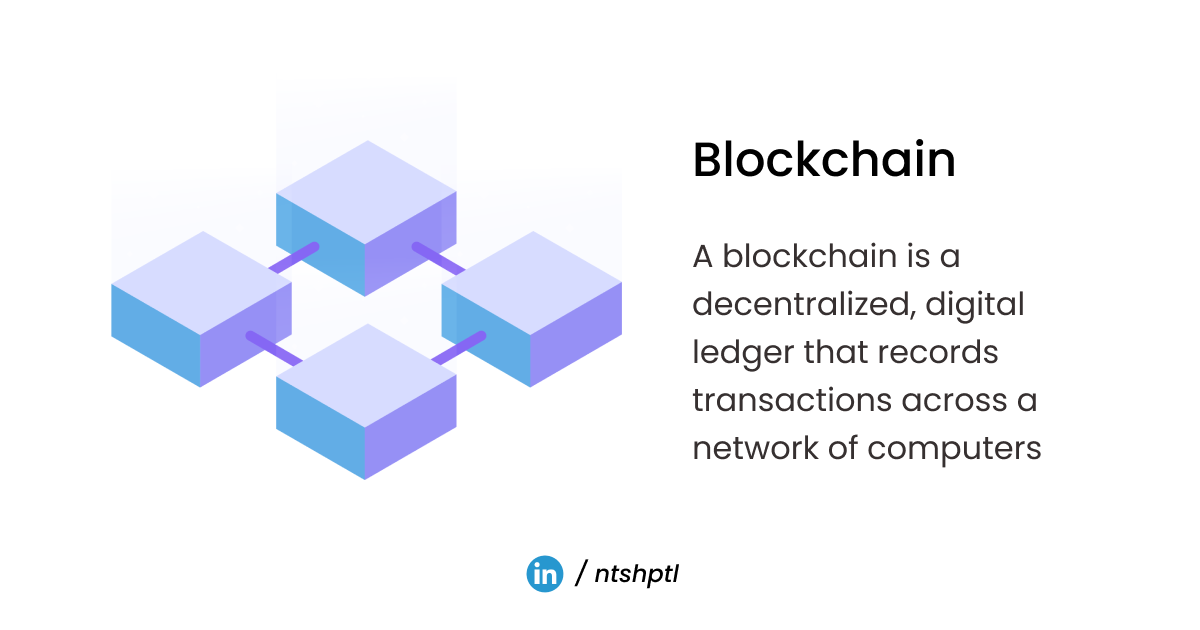
Blockchain : Just like how a notebook is made up of many pages, a blockchain is made up of many blocks, each block contains some group of data, and has information about the previous block, hence forming the chain. This chain is public, so anyone can see what transactions are done. So overall a blockchain is an digital ledger that keeps track of buying and selling or moving money around.
Mining : Blockchain mining is the process of adding new blocks to the blockchain. It's like a digital version of prospecting for gold. Miners use powerful computers to search for a certain solution to a complex mathematical problem. Just like how gold miners have to dig deep into the earth to find gold, miners have to solve complex equations to find the right solution in order to add a new block to the blockchain.
Wallet: This is generally a combination of Public key and private key , but to keep it really simple in general its a string of characters which represents an address which represensts an identity using which one can interact with the blockchain.

So after looking it at all of the above terms, you might be wondering this all sounds okay and is completely doable in a web2 world, then why does words like Distributed, Anonymous , Tamper proof come in to picture? The following terms in combination with the above is what makes a perfect blockchain.
Node: Let’s say you have a notebook using which you keep a track of all the transactions you do among a group of friends, now a similar notebook is maintained by all the other friends in the group, and everytime a transaction is done everyone updates their notebook. Keeping the data secure so incase anyone’s book is lost a similar one can be created by refering from the other available books. So A Node is esentially maintains a copy of the blockchain on their system, as well as help to create the blocks using the mining concept explained above.
Consensus : Consensus is the process of getting all the participants agree on the current state of the ledger. Imagine a group of friends making a decision like, which restaurant to go for lunch, Everyone has their own opinion and they need to come to a consensus(agreement) on where to eat. In blockchain the participants i.e nodes come to an agreement on whether or not the block in valid in the mining process before its being added to the chain.
Decentralized : Since the node is not maintained by a single entity, but is maintained by a number of people and hence its considered as decentralized because the system or network is not controlled by a single entity.
Cryptos: Cryptocurrency, or simply crypto, is a digital or virtual currency that uses cryptography for security. Cryptocurrency operates independently of a central bank, and is decentralized in nature.

Now that we are familiar with some of the terms, it can still be challenging to explain blockchain to others in a conversation. To make it more understandable, let's use everyday life examples to explain what blockchain is.
Now that we are aware about some of the terms, its still difficult to explain all of these to everyone over an conversation. So Let’s see how we can explain others what blockchain is using their day to day life metaphors
Starting off with Parents:
I would explain blockchain to my mom with the example of an diamond necklace, where each diamond represents a block of transaction, an each diamond in the necklace is connected to the other diamonds(blocks) in the chain. Another way to explain blockchain would be gossips , Moment my mom hears an intresting hot topic, she will spread that information to other people , here each person can be considered has a block. Just like how gossips pass from one person to person, information is passed from block to block in blockchain. Just like how gossips can be spread over a wide area, the information in the blockchain can be spread over a wide network of computers.
On the similar lines Blockchain can also be explained using the anology of an train, Imagine a train network where each train car represents a block of information, and each block is connected to the previous one, creating a chain. This chain of blocks is the "blockchain.” Just like how a train can't move forward without being connected to the cars in front of it, each block in the blockchain can't be added or altered without being connected to the previous block. This creates a secure and unchangeable record of information, like a digital ledger. And just like how the train needs a conductor to check the information and driver to keep the train moving, the blockchain needs a consensus method and network of computers to validate and add new blocks to the chain.

Doctors
Blockchain can be easily expalined to doctors using patient health records. Each patient's record is a "block" in the chain, and each block contains information about that patient's health history.
The health record is shared among all the doctors and hospitals who treat that patient, just like how all the computers in a blockchain network have access to all the blocks. And just like how multiple doctors and hospitals can add to a patient's health record, multiple users can add to the blockchain by creating new blocks.
Also, just like how a doctor's signature is required for a patient's health record, each block in a blockchain has a unique "digital signature" that verifies its authenticity. This ensures that no one can tamper with a patient's health record or a block in the blockchain.

Bankers / Finance Folks
Blockchain is alreay quite popular in the finance space, infact there is even a term DeFi which means Decentralized finance. More about DeFi in futrue news letter, but the core blockchain terms can be explained with an analogy of a bank just as a traditional bank keeps track of all the customer transactions and balances, the blockchain maintains a distributed ledger which has informations about all the Transactions happened on the blockchain.
In this case, instead of having one central institution like a bank that controls and maintains record, a blockchain is mainted by a network of computers(nodes) all around the world. Each of this nodes helps in maintaing a safe , secure and transparent blockchain, similar to how a bank relies on multiple employees and technical systems to keep track of customer accounts. And just as a bank uses various security measures to protect its customers' information, blockchain technology uses advanced encryption and other techniques to ensure that the information on the blockchain is secure and tamper-proof.

Software Developers
A traditional Full Stack developer can simply consider a database like mysql, postgres but instead of it being running on a single machine / instance, its spread across multiple machines around the world and is much more secure then and resistant to tampering than a traditional database.
Lawyers
Blockchain technology can be easily explained to lawyers as a digital ledger that records agreements and transactions in a secure, transparent, and tamper-proof way. It can be used to represent legal ownership of assets such as property, rental agreements, and other contractual agreements. By recording these transactions on the blockchain, lawyers can easily track the ownership transfers and progress of a case. This is particularly helpful due to the immutable nature of blockchain, which ensures that the records cannot be altered or deleted. Additionally, the public nature of blockchain technology allows for easy tracking of the past history of an asset, providing a comprehensive and verifiable record for all parties involved.
Marketing Managers / Content Creators / Entertainment Industry

Blockchain technology can be explained using the analogy of Intellectual Property (IP) rights.
Just as IP rights are used to protect the ownership and rights of creative works such as music, films, and paintings, blockchain technology is used to protect the ownership and rights of digital assets. In the same way that IP rights are managed by centralized authorities, traditional digital assets are also managed by centralized parties such as banks or government institutions.
Just like how IP rights can be assigned, transferred and licensed, digital assets can also be moved and tracked on blockchain. On the blockchain, each digital asset is represented as a unique digital token and the ownership of that token is linked to a specific person or entity. This creates a tamper-proof record of the ownership and rights of the asset, allowing for easy tracking and management.
Blockchain can also replace the IP Rights system by smart contracts.
Above were a few examples of how blockchain can be explained to certain professions, I will be also soon writing about usecases of Blockchains and more content around web3 which is easy to digest
If you liked this newsletter and has helped you understand blockchain, Please Consider Subscribing to the newsletter.